

Since July 2025, TNB bills in Peninsular Malaysia break your electricity cost into separate components instead of one block rate. The new detailed bill ("Bil Terperinci Anda") is more transparent, but it can look confusing at first. This guide walks through each section using a real bill from a home with solar under Solar ATAP. Personal details have been partly hidden. (Running a business? See our separate guide to reading a business TNB bill.)
Part 1: The header
| Field | What it means |
|---|---|
| No. Akaun | Your TNB account number. Use this for payments and enquiries. |
| Alamat Premis | The address where the electricity is supplied. |
| Maklumat Bayaran Akhir | Your last payment: the amount and the date it was received. |
| Tempoh Bil | The billing period and number of days. Compare bills with similar day counts. |
| No. Sijil ATAP Suria | Appears only if you have solar under Solar ATAP. This is your ATAP reference number. |
Part 2: The charges table, line by line
The main table has three columns of figures: Tanpa Cukai Perkhidmatan (usage not subject to service tax), Dengan Cukai Perkhidmatan (usage subject to 8% service tax) and Jumlah (total). For homes, the first 600 kWh each month is not taxed; from September to December 2026 this was temporarily raised to 800 kWh.
Usage (kWh)
On the standard tariff you see one usage line. If you are on the Time of Use tariff, usage is split into Puncak (peak: 2pm to 10pm, Monday to Friday) and Luar Puncak (off-peak: all other times).
Caj Penjanaan (generation charges)
- Tenaga (Energy charge): the cost of the electricity itself, in RM per kWh. For homes, it is 27.03 sen/kWh if you use 1,500 kWh or less in the month, and 37.03 sen/kWh if you use more. ToU has its own peak and off-peak rates.
- AFA (Automatic Fuel Adjustment): a monthly adjustment based on fuel costs. It can be a surcharge or a rebate, and it changes every month. Homes using 600 kWh or less (800 kWh from September to December 2026) are protected from AFA surcharges.
- Kapasiti (Capacity charge): pays for power-station capacity and standby reserves. 4.55 sen/kWh for homes.
Network and retail charges
- Caj Rangkaian (Network charge): pays for the transmission and distribution grid that delivers electricity to you. 12.85 sen/kWh for homes.
- Caj Peruncitan (Retail charge): a fixed RM10 a month for homes, covering billing and customer service. Waived if you use 600 kWh or less (800 kWh from September to December 2026).
Other charges and credits
- Insentif Cekap Tenaga (Energy Efficiency Incentive): a rebate for homes using 1,000 kWh or less. The less you use, the higher the rebate per kWh.
- Caj Penggunaan Bulan Semasa: the subtotal of this month's usage charges.
- Cukai Perkhidmatan (8%): service tax, calculated only on the "Dengan Cukai" column.
- KWTBB (1.6%): Kumpulan Wang Tenaga Boleh Baharu, the Renewable Energy Fund levy. It funds Malaysia's renewable energy programmes. It is calculated on the main usage charges (energy, capacity and network).
- Kredit ATAP Suria: if you have solar, this shows how much electricity you exported ("Lebihan Penjanaan Anda") and the credit it earned.
- Caj Semasa: the amount due for this billing period.
Worked example: a home with solar under Solar ATAP (Time of Use)
This household is on the ToU tariff and used 1,838 kWh from the grid in September 2026 (368 kWh peak and 1,470 kWh off-peak). It also exported surplus solar to the grid. Here is the actual bill, followed by how each figure is calculated.
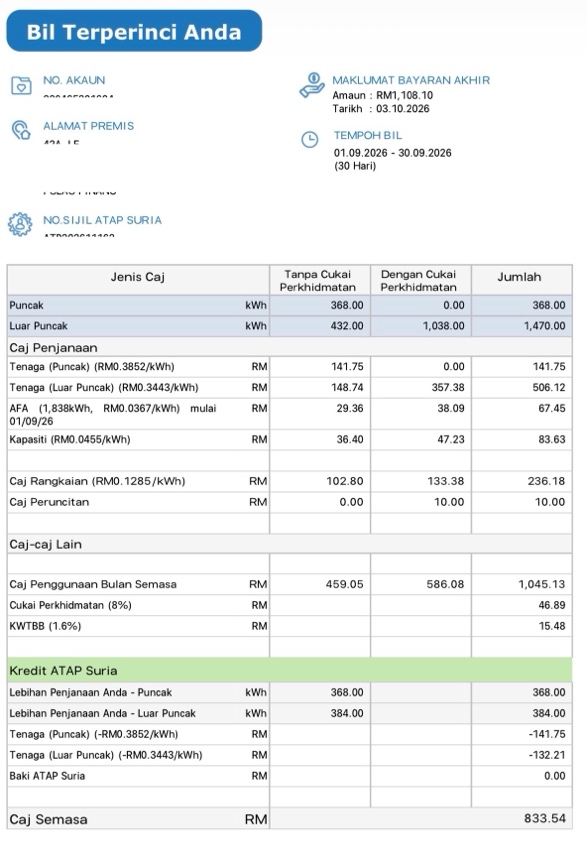
Residential TNB bill with Solar ATAP credit (September 2026)
| Bill line | Calculation | Amount (RM) |
|---|---|---|
| Energy, peak | 368 kWh × 38.52 sen | 141.75 |
| Energy, off-peak | 1,470 kWh × 34.43 sen | 506.12 |
| AFA (September 2026) | 1,838 kWh × 3.67 sen | 67.45 |
| Capacity | 1,838 kWh × 4.55 sen | 83.63 |
| Network | 1,838 kWh × 12.85 sen | 236.18 |
| Retail | Fixed | 10.00 |
| Usage charges this month | 1,045.13 | |
| Service tax 8% | On taxed portion (RM586.08) | 46.89 |
| KWTBB 1.6% | On energy + capacity + network | 15.48 |
| ATAP credit, peak export | 368 kWh × 38.52 sen | -141.75 |
| ATAP credit, off-peak export | 384 kWh × 34.43 sen | -132.21 |
| Caj Semasa (amount due) | 833.54 |
What this bill tells us
- Crossing 1,500 kWh is costly. Because total usage was above 1,500 kWh, the higher energy rates (38.52 and 34.43 sen) applied to every unit, not just those above the threshold.
- Export is not 1-to-1. Each exported unit is credited only at the energy charge rate. Every unit imported from TNB also carries AFA, capacity and network charges (about 21 sen more per kWh here, plus taxes). Using solar directly is worth more than exporting it.
- Credits only offset what you buy. In this bill, the peak export credited (368 kWh) exactly matches peak usage (368 kWh), and the remaining ATAP balance ("Baki ATAP Suria") is RM0.00. Under Solar ATAP, unused credit is not carried forward to the next month.
- The first 800 kWh was not taxed because of the temporary September to December 2026 relief.
Even so, solar credits cut this bill from about RM1,108 to RM833.54, a saving of about RM274 in the month, on top of the savings from the solar the household used directly, which never appears on the bill at all.
Quick checklist each month
- Compare total kWh with the same month last year, not just the ringgit amount.
- Note the AFA rate; it explains much of the month-to-month change.
- Check whether you are close to the 600/800, 1,000 or 1,500 kWh thresholds.
- If you have solar, check the ATAP credit and whether any balance went unused.
- Pay on time to avoid late payment surcharges.
Key takeaways
Bills now show energy, AFA, capacity, network and retail charges separately.
Service tax applies only to the taxed column; the first 600 kWh (800 kWh until December 2026) is exempt for homes.
Going above 1,500 kWh raises the energy rate on your whole month's usage.
Solar ATAP credits exports at the energy charge only, and unused credit is not carried forward.
Using solar directly is worth more than exporting it, so size your system around your own usage.
Talk to Mercure Engineering
Send us a photo of your TNB bill on WhatsApp. Mercure Engineering will explain where your money goes and show you how much solar could save.
References
- TNB: Understanding your bill
- TNB press release (2 Oct 2026): Bill adjustment for households up to 800 kWh
- RinggitPlus: Your new TNB bill explained
- SAYS: How Time of Use pricing works
Related guides
5 Ways to Lower Your Electricity Bills
Reading Your Business TNB Bill: A Guide for Factory and Shop Owners