

For factories, workshops, shops and offices, electricity is often one of the largest operating costs, yet many business owners only look at the final amount. Since July 2025, non-domestic bills in Peninsular Malaysia follow the same itemised format as homes, but with different rates and a few extra items that are worth understanding. This guide uses a real factory bill (personal details partly hidden) to show what to look for.
If you have not read it yet, our guide to reading a home TNB bill explains the basic layout and terms. This article focuses on what is different for businesses.
How business bills differ from home bills
| Item | Home (domestic) | Business (non-domestic, low voltage) |
|---|---|---|
| Energy charge | 27.03 sen/kWh (37.03 sen above 1,500 kWh) | Set by tariff category; 27.03 sen/kWh on this bill |
| Capacity charge | 4.55 sen/kWh | 8.83 sen/kWh |
| Network charge | 12.85 sen/kWh | 14.82 sen/kWh |
| Retail charge | RM10 a month (waived at low usage) | RM20 a month on this bill |
| Energy Efficiency Incentive | Yes, for usage up to 1,000 kWh | Not applicable |
| Solar ATAP export credit | Energy charge rate | Average System Marginal Price (SMP) |
The biggest difference is in the capacity and network charges. For this low-voltage business, they add about 23.65 sen to every kWh, over 6 sen more than for a home. Medium-voltage customers are charged differently again: capacity and network charges are based on maximum demand (RM per kW), so reducing your highest demand peak matters as much as reducing total kWh.
Worked example: a factory bill
This factory used 161,251 kWh in June 2026. Here is the bill, followed by how each figure is calculated.
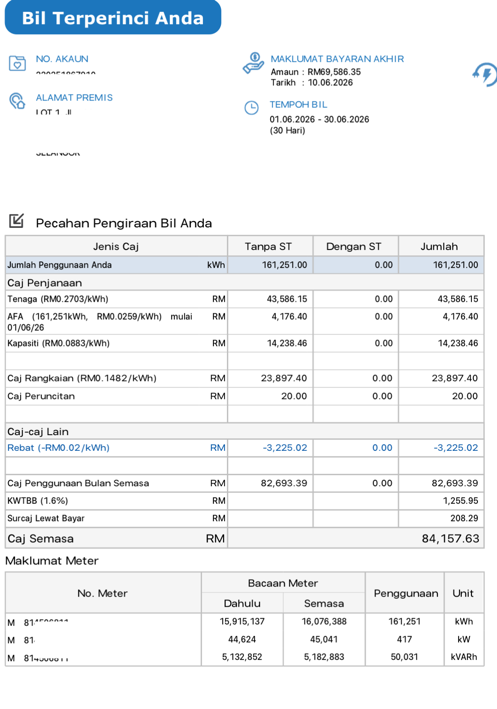
Non-domestic (factory) TNB bill (June 2026)
| Bill line | Calculation | Amount (RM) |
|---|---|---|
| Energy | 161,251 kWh × 27.03 sen | 43,586.15 |
| AFA (June 2026) | 161,251 kWh × 2.59 sen | 4,176.40 |
| Capacity | 161,251 kWh × 8.83 sen | 14,238.46 |
| Network | 161,251 kWh × 14.82 sen | 23,897.40 |
| Retail | Fixed | 20.00 |
| Rebate | 161,251 kWh × -2 sen | -3,225.02 |
| Usage charges this month | 82,693.39 | |
| KWTBB 1.6% | On energy + capacity + network, after rebate | 1,255.95 |
| Late payment surcharge (Surcaj Lewat Bayar) | 208.29 | |
| Caj Semasa (amount due) | 84,157.63 |
This bill shows no service tax. Service tax treatment for non-domestic users depends on the type of business, so check how your own category is treated.
Read the meter section (Maklumat Meter)
Below the charges, business bills list the meter readings. On this bill there are three:
| Reading | This month | What it tells you |
|---|---|---|
| kWh | 161,251 | Total energy used. This drives energy, AFA, capacity and network charges for low-voltage customers. |
| kW | 417 | Maximum demand: the highest power drawn at any one time during the month. For medium-voltage customers, this directly sets capacity and network charges. |
| kVARh | 50,031 | Reactive energy, drawn by motors, compressors and other inductive equipment. It is used to work out your power factor. |
Check your power factor
Power factor shows how efficiently your premises uses the electricity supplied. You can estimate it from the bill:
Power factor = kWh ÷ √(kWh² + kVARh²) = 161,251 ÷ √(161,251² + 50,031²) ≈ 0.95
A power factor of 0.95 is healthy. If it falls below TNB's required level, a power factor surcharge is added to the bill. A low power factor is usually corrected by installing or repairing capacitor banks, which often pays for itself quickly.
Four things every business owner should check
- Pay on time. The RM208.29 late payment surcharge on this bill could have been avoided entirely.
- Watch capacity and network charges. At about 23.65 sen/kWh for low-voltage businesses, they are a large share of the bill and fall with every kWh you no longer buy from the grid.
- Track maximum demand. Staggering the start-up of large motors, compressors and air-conditioning can lower your peak kW, which matters most on medium-voltage tariffs.
- Keep power factor healthy. Check kVARh each month; a sudden rise can signal failed capacitors.
How solar helps businesses
Businesses are often an even better match for solar than homes. Most factories, shops and offices use the bulk of their electricity during the day, exactly when solar generates. Every kWh of solar used directly avoids the energy, AFA, capacity and network charges together, roughly 53 sen/kWh on this bill (27.03 + 2.59 + 8.83 + 14.82 sen) before the rebate.
Under Solar ATAP, surplus exported by non-domestic customers is credited at the average System Marginal Price (SMP), which is lower than the domestic export rate and changes over time. Unused credit is not carried forward. This makes it important to size a business system around daytime consumption so that almost all of the solar is used on site. Businesses may also be eligible for green investment tax incentives such as the Green Investment Tax Allowance (GITA); check the latest terms with MIDA or your tax adviser.
Key takeaways
Business bills use the same format as homes but with higher capacity and network charges (8.83 and 14.82 sen/kWh for this low-voltage factory).
Medium-voltage customers pay capacity and network charges on maximum demand (RM/kW), so peak demand matters.
Use the kWh and kVARh readings to check your power factor; this factory's is about 0.95.
Late payment surcharges are completely avoidable.
Daytime-heavy businesses are an excellent match for solar; size the system for self-consumption because exports earn only the SMP.
Talk to Mercure Engineering
Send us your latest business TNB bill on WhatsApp. Mercure Engineering will review your usage, demand and power factor, and prepare a solar proposal sized to your daytime load.
References
- TNB: Understanding your bill
- SEDA Malaysia: Solar ATAP general information
- Focus Malaysia: New electricity tariff with five billing components
- Business Today (Jul 2025): New tariff structure overview
Related guides
How to Read Your TNB Electricity Bill