
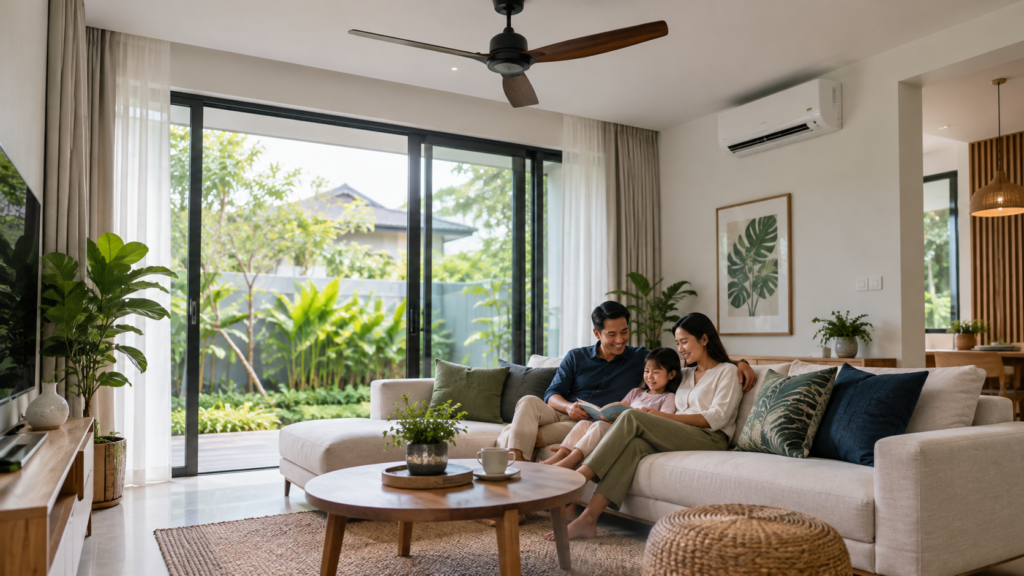
Since TNB's new tariff structure took effect in July 2025, many households have noticed their bills behave differently. The good news is that the new structure also gives you more ways to save. Start with manageable everyday changes before investing in new equipment, then consider bigger upgrades once you know where your electricity goes.
1. Cool smarter
In most Malaysian homes, air-conditioning is the single biggest electricity user. Small changes here make the biggest difference.
- Set the air-conditioner to around 24°C where comfortable, rather than cooling more than needed. Each degree cooler makes the compressor work harder.
- Use a ceiling or standing fan together with the air-conditioner. Moving air feels cooler, so you can keep the temperature setting higher.
- Use the timer or sleep mode so the unit is not running at full power until morning.
- Keep doors and windows closed while cooling, and draw curtains or blinds on west-facing windows in the afternoon.
- Clean filters regularly and service units on schedule. Dirty coils and filters reduce cooling and increase power use.
- When replacing old units, choose an inverter model sized correctly for the room.
2. Know the thresholds on your bill
Under the current domestic tariff, a few usage levels matter a lot. Staying just below them can save more than you might expect.
| Monthly usage | What changes |
|---|---|
| 600 kWh and below | No RM10 retail charge, no AFA surcharge and no 8% service tax. (From September to December 2026, this protection has been temporarily extended to 800 kWh.) |
| Up to 1,000 kWh | You receive the Energy Efficiency Incentive (Insentif Cekap Tenaga) rebate. The lower your usage, the bigger the rebate per kWh: up to 25 sen/kWh for 200 kWh and below, tapering to 0.5 sen/kWh at 901 to 1,000 kWh. |
| Above 1,500 kWh | The energy charge rises by 10 sen/kWh (from 27.03 to 37.03 sen on the standard tariff), and the higher rate applies to the whole month's usage, not just the units above 1,500. |
For example, on the standard tariff, a home using 1,550 kWh pays about RM574 in energy charges alone. Cut usage to 1,450 kWh and the energy charge drops to about RM392, a difference of around RM180 for 100 fewer units. Large homes near this threshold have a strong reason to manage usage or add solar.
3. Use Time of Use (ToU) if it suits your routine
Homes with a TNB smart meter can opt for the Time of Use tariff, which charges less outside peak hours.
| Energy charge | Peak (2pm to 10pm, Mon to Fri) | Off-peak (all other times, weekends and selected public holidays) |
|---|---|---|
| Usage 1,500 kWh and below | 28.52 sen/kWh | 24.43 sen/kWh |
| Usage above 1,500 kWh | 38.52 sen/kWh | 34.43 sen/kWh |
If you can shift laundry, dishwashing, water heating and EV charging to late night, early morning or weekends, ToU can lower your bill. If most of your usage falls on weekday evenings, it may cost more. Use the bill calculator on the myTNB website to compare before switching.
4. Choose efficient lighting and appliances, and use them well
- Switch to LED lighting and turn lights off in unoccupied areas.
- Reduce unnecessary use. Switch appliances off at the wall when not needed, especially TV boxes, game consoles and storage water heaters, while keeping essential equipment running.
- Use appliances efficiently. Wash full loads where suitable, keep the refrigerator's airflow clear, check that door seals close tightly, and avoid putting hot food straight into the fridge.
- Compare before replacing. Check the Energy Commission (Suruhanjaya Tenaga) star-rating label when buying air-conditioners, refrigerators, fans, TVs and washing machines; 5 stars is the most efficient. Choose a capacity that matches what your space actually needs.
5. Generate your own electricity with solar
Once you have trimmed waste, rooftop solar tackles the units you cannot avoid. Every unit of solar you use directly is a unit you do not buy from TNB, saving the energy, capacity and network charges together. Under Solar ATAP, surplus solar earns credit on your bill, and eligible homeowners can claim up to RM3,000 through the SuRIA Home rebate for systems commissioned by 31 December 2026. Solar can also keep large homes below the 1,500 kWh threshold. See our guides to solar PV and to the Solar ATAP programme to learn more.
Your next step
Compare your electricity consumption in kWh (not just ringgit) over similar billing periods to see whether your changes are working. Ringgit amounts move with the monthly AFA rate and rebates, but kWh shows your real usage. The myTNB app makes this easy to track month by month.
Key takeaways
Air-conditioning is usually the biggest load: set it to around 24°C, use fans, timers and regular servicing.
Watch the 600/800 kWh, 1,000 kWh and 1,500 kWh thresholds; crossing 1,500 kWh raises the rate on every unit.
Time of Use can help if you can shift usage away from weekday 2pm to 10pm.
Choose LED lighting and 5-star appliances sized to your needs.
Solar cuts the units you cannot avoid, with up to RM3,000 in SuRIA Home rebates available in 2026.
Talk to Mercure Engineering
Want to see how much solar could cut your bill? Send us your recent TNB bills on WhatsApp and Mercure Engineering will give you a free usage review and solar estimate.
References
- SAYS: How does Time of Use (ToU) electricity pricing work?
- RinggitPlus: Your new TNB bill explained
- TNB press release (2 Oct 2026): Bill adjustment for households up to 800 kWh
- SoyaCincau: TNB domestic tariff structure from July 2025
Related guides
How to Read Your TNB Electricity Bill
NEM and Solar ATAP: Understanding the Programmes
SuRIA Home Rebate: How to Claim Up to RM3,000 for Your Home Solar System