
Under the old NEM scheme, the grid acted like a free battery: export your surplus in the day, take it back at night at full value. Solar ATAP changed that. Exports are now credited at a lower rate, and unused credit is not carried forward. As a result, more Malaysian homeowners are asking whether they should store their own solar instead.
Why batteries are getting attention under Solar ATAP
- Export is no longer 1-to-1. A kWh you export earns only the energy charge (27.03 sen/kWh on the standard domestic tariff). A kWh you import costs at least 44.43 sen once capacity and network charges are added, plus AFA and taxes.
- Most homes are empty during the day. With adults at work and children at school, much of the solar is exported at the lower rate, then electricity is bought back at the higher rate in the evening when the air-conditioners come on.
- Unused credit is lost. If you export more than you buy in a month, the excess credit is forfeited.
A battery solves this by charging from your solar in the afternoon and powering your home at night, so more of your solar is used at full value and less is wasted.
How a battery fits into your system
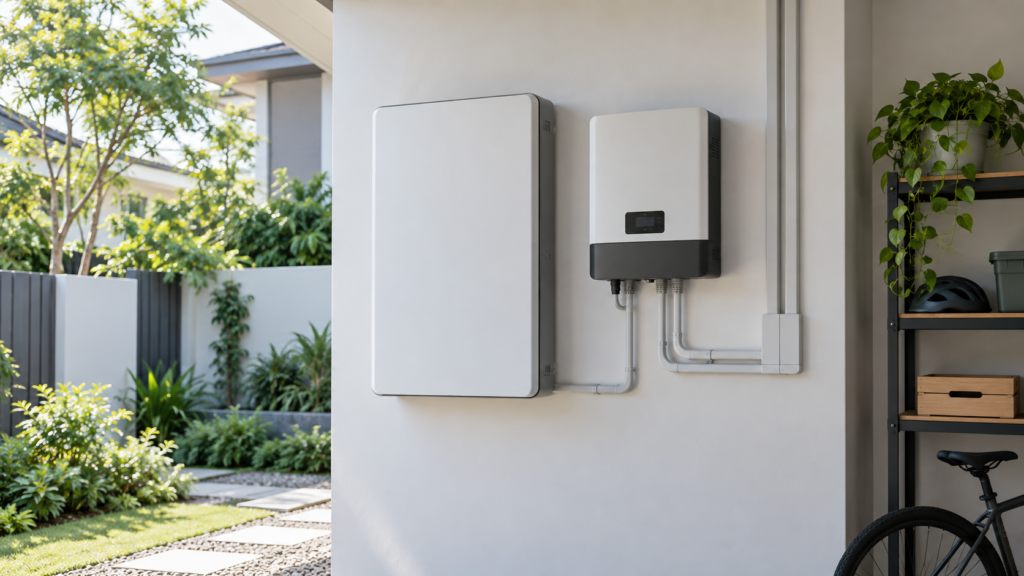
A home battery is usually paired with a hybrid inverter, which manages the panels, battery and grid together. During the day, solar powers the home first, then charges the battery, and only then exports to the grid. In the evening, the battery discharges to cover your load until it reaches its set minimum, after which the grid takes over. Most home batteries in Malaysia use lithium iron phosphate (LFP) chemistry, which is known for long cycle life, good thermal stability and safety.
How to size a battery
Battery sizing is not one-size-fits-all. We customise it to each household based on four things:
- Your evening and night usage. How many kWh does your home use from sunset to morning? Air-conditioners in bedrooms are usually the largest share.
- Your daytime solar surplus. How much does your system generate beyond what the home uses during the day?
- Your budget. A battery is a significant add-on, so the size can be adjusted to what makes sense for you, with room to expand later on modular systems.
- Whether you want backup. If you need power during outages, the system must be designed for backup, and the inverter's power rating (kW) must handle the appliances you want to run.
As a rule of thumb, there is little benefit in a battery larger than your daily surplus (it will not fill) or larger than your night usage (it will not empty).
A worked example
Say your solar system generates about 20 kWh a day, and almost nobody is home during the day. Without a battery, most of that 20 kWh is exported at the energy charge rate. With a battery sized for 16 kWh:
| Without battery | With a 16 kWh battery |
|---|---|
| About 20 kWh exported, credited at 27.03 sen/kWh | 16 kWh stored for the evening; the balance of 4 kWh is used by daytime appliances or exported |
| Evening usage bought from TNB at 44.43 sen/kWh or more | Evening usage covered by the battery (about 14.5 to 15 kWh delivered after charging losses) |
| Export credit may go unused if it exceeds what you buy | Very little export, so almost nothing is wasted |
How much does the battery save? Every kWh your battery supplies at night is a kWh you do not buy from TNB. You save the energy charge (27.03 sen), the capacity charge (4.55 sen) and the network charge (12.85 sen), a total of 44.43 sen per kWh, plus AFA and taxes where they apply. If the battery delivers about 15 kWh a night, that is around 450 kWh a month, or about RM200 a month of night-time electricity you no longer buy.
For a fair comparison, account for charging losses and the export credit given up. In this simplified 30-day example, 15 kWh delivered nightly avoids about RM199.94 in imports, while 16 kWh charged daily gives up about RM129.74 in export credit at 27.03 sen/kWh, if that credit would otherwise be fully used. The additional benefit is therefore about RM70 a month. It approaches RM200 only when the corresponding export credit would otherwise be forfeited. Actual savings depend on household use, losses, tariff adjustments, rebates and taxes.
What does a home battery cost? (estimate)
Battery prices have fallen sharply worldwide. BloombergNEF's 2025 survey found that battery pack prices for stationary storage dropped 45% in a single year, to about US$70 per kWh, making home batteries far more affordable than they were even a few years ago. Estimated battery prices in the Malaysian market (as of October 2026):
| Battery size | Estimated price | Typically suits |
|---|---|---|
| 5 to 6 kWh | about RM3,900 | Smaller homes, or covering lights, fans, fridge and one bedroom air-conditioner for part of the night |
| 10 to 11 kWh | about RM5,800 | A typical family's evening and night usage |
| 15 to 16 kWh | about RM7,600 | Larger homes with several bedroom air-conditioners running at night |
These are estimates for the battery only. Actual prices vary with brand, warranty and supplier, so always ask for a written quotation. Your total cost also depends on:
- Inverter: whether your existing inverter is battery-ready, or a hybrid inverter must be added or swapped.
- Brand and warranty: most quality LFP batteries carry a 10-year warranty, with a guaranteed capacity retained at the end.
- Backup features: automatic backup during outages needs additional switching and wiring.
- Installation: location, cable runs and any wall mounting or protection needed.
Using the estimated RM7,600 battery price and the simplified RM70–RM200 monthly additional benefit above gives a battery-only simple payback of approximately 3–9 years. This is an illustration, not a guaranteed return. It excludes any additional inverter, installation, financing and maintenance costs, and changes from degradation, tariffs or rebates. Use a complete installed quotation and household consumption profile for a meaningful assessment. Backup power also requires compatible equipment and a system designed for the intended essential loads.
What to expect after installation
- Usable vs rated capacity. Check the usable kWh, not just the nominal figure. Some capacity is reserved to protect battery life.
- Charging losses. Expect about 5 to 10% of energy to be lost in charging and discharging.
- Gradual ageing. Capacity declines slowly over the years; warranties guarantee a minimum remaining capacity.
- Placement matters. Install in a shaded, well-ventilated spot such as a porch or store room, away from direct sun and rain. Malaysia's heat shortens battery life if ventilation is poor.
- Backup is not automatic. Not every battery setup powers the home during a blackout. If backup matters to you, say so at the design stage.
- Monitoring. Your app shows charge levels, solar generation and grid use, so you can see exactly how much the battery is saving.
- Compliance. The battery must be installed by a qualified installer and comply with SEDA and TNB requirements for your Solar ATAP system.
Is a battery right for you?
| A battery makes more sense if… | You may not need one yet if… |
|---|---|
| Your home is empty most of the day | Someone is at home during the day and uses the solar directly |
| You export a lot and some credit goes unused | Your export credit is fully used each month |
| Your evening usage is high (bedroom air-conditioning, EV charging at night) | Your night usage is low |
| You want backup power during outages | Outages are rare and short where you live |
| Your monthly usage is near or above 1,500 kWh | Your budget is better spent on more panels first |
Key takeaways
Under Solar ATAP, exports are credited at the energy charge only and unused credit is forfeited, which makes storage more attractive.
Batteries help most in homes that are empty during the day and use more power at night.
Size the battery to the smaller of your daytime surplus and your night usage, then adjust to your budget.
Each kWh supplied by the battery at night saves 44.43 sen (energy + capacity + network); estimated battery prices are about RM3,900 (5 to 6 kWh), RM5,800 (10 to 11 kWh) and RM7,600 (15 to 16 kWh).
Panels first, battery later is a sensible path for many homes; choose a hybrid-ready inverter.
Talk to Mercure Engineering
Not sure if a battery is worth it for your home? Mercure Engineering will review your bills and daily usage pattern, then propose a battery size that matches your budget, with a clear estimate of what it will and will not save. WhatsApp us to get started.
References
- SEDA Malaysia: Solar ATAP general information
- SoyaCincau: TNB domestic tariff structure from July 2025
- SAYS: How Time of Use pricing works
- BloombergNEF 2025 battery price survey (summary via DieselNet): stationary storage packs down 45% to US$70/kWh
Related guides
Solar PV Systems: What Homeowners Should Know