
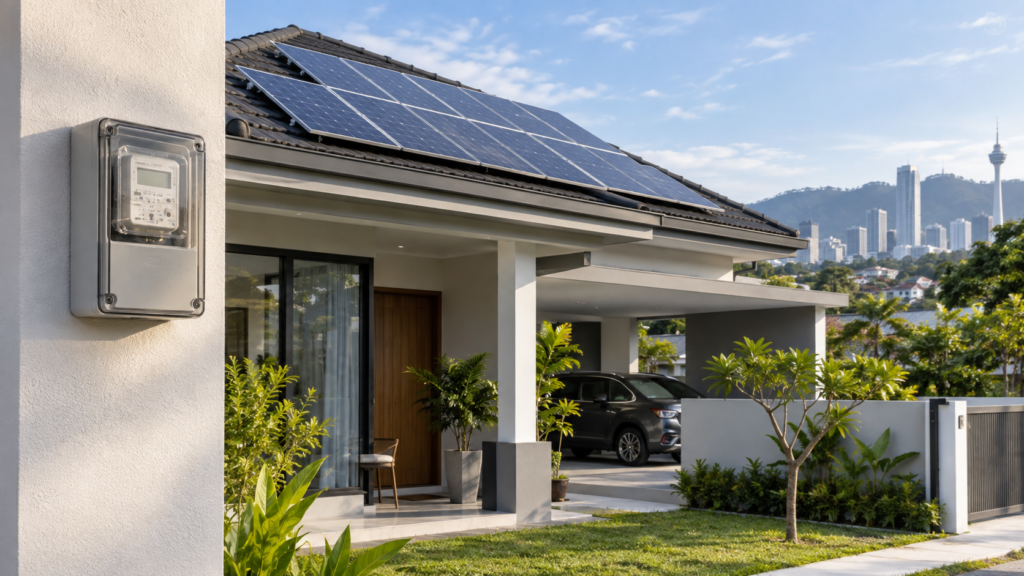
If you have spoken to friends who installed solar a few years ago, you may have heard about "1-to-1 offset" and wondered why your quotation looks different today. Malaysia's rooftop solar rules have changed several times. Here is how we got here, what Solar ATAP means for you, and how the RM3,000 SuRIA Home rebate fits in.
A short history of solar schemes in Malaysia
| Scheme | Period | How it worked |
|---|---|---|
| Feed-in Tariff (FiT) | From 2011 | Introduced under the Renewable Energy Act 2011 and administered by SEDA. Owners sold all the electricity their panels produced to TNB at a fixed premium rate for 21 years. It was funded by the 1.6% KWTBB levy you still see on your bill today. |
| NEM 1.0 | From 2016 | Net Energy Metering replaced FiT for new rooftop systems. Solar was used at home first, and surplus was credited at a lower "displaced cost" rate (about 31 sen/kWh), below what households paid to import. Uptake was slow. |
| NEM 2.0 | From 2019 | Introduced the true 1-to-1 offset: every kWh exported offset one kWh imported at the full tariff rate. Uptake grew strongly. |
| NEM 3.0 | 2021 to 30 June 2025 | Split into NEM Rakyat (homes), NEM GoMEn (government) and NEM NOVA (commercial and industrial), each with its own quota. Homes kept the 1-to-1 offset. Originally due to end in December 2024, it was extended to 30 June 2025. |
| Solar ATAP | From 1 January 2026 | The current programme, under Energy Commission guideline GP/ST/No. 60/2025. It prioritises self-consumption and credits exports at the energy charge rate. |
Along the way, the government also ran the SolaRIS cash rebate (up to RM4,000) in 2024 to 2025. Its successor for 2026 is SuRIA Home, covered below. Existing NEM customers continue under the terms of their original agreements; Solar ATAP applies to new installations.
What is Solar ATAP?
ATAP stands for the Solar Accelerated Transition Action Programme, and "atap" also means "roof" in Malay. Like NEM, it lets you install solar for your own use and export surplus electricity to the grid in exchange for bill credits. Key rules for homes:
- System size: domestic installations above 5 kW single-phase or 15 kW three-phase require a Connection Confirmation Check (CCC); the proposed capacity is subject to technical approval.
- Export credit: for domestic customers, each exported kWh is credited at the energy charge rate (for example, 27.03 sen/kWh on the standard tariff for usage of 1,500 kWh or below, or the peak and off-peak energy rates on Time of Use). Non-domestic customers are credited at the average System Marginal Price (SMP).
- No carry-forward: credit can only offset what you buy in the same billing period. Unused credit is forfeited.
- Contract period: 10 years. After that, the system continues to run for self-consumption, but exports no longer earn credit.
- How to apply: through a SEDA-registered PV Service Provider (RPVSP), who submits the application on SEDA's eATAP system.
NEM 3.0 vs Solar ATAP at a glance
| Feature | NEM 3.0 (NEM Rakyat) | Solar ATAP |
|---|---|---|
| Status | Closed to new applications from 1 July 2025 | Open since 1 January 2026 |
| Quota | Capped quotas (e.g. 400 MW for NEM Rakyat) | No overall quota announced |
| Value of exported energy (homes) | 1-to-1: one exported kWh offsets one imported kWh at the full rate | Energy charge rate only; does not include capacity, network or AFA |
| Unused credit | Carried forward to later bills | Forfeited at the end of each billing period |
| Best strategy | Size the system large; export freely | Size to your usage; use as much solar directly as possible |
| Rebate | SolaRIS (until 2025) | SuRIA Home, up to RM3,000 (2026) |
What the change means in ringgit
When you import a kWh on the standard domestic tariff, you pay the energy charge (27.03 sen), plus capacity (4.55 sen) and network (12.85 sen): 44.43 sen before AFA and taxes. Under Solar ATAP, an exported kWh earns 27.03 sen. So:
- Every kWh of solar you use directly is worth about 44 sen or more.
- Every kWh you export is worth about 27 sen, as long as you buy enough from TNB that month to use the credit.
This is why solar is still worthwhile under ATAP, but the design approach has changed. Systems should be sized around your actual consumption, and households that are out during the day should think about shifting loads (washing, water heating, EV charging) to daytime or adding a battery.
Malaysia is not alone in this shift. Many countries that started with generous feed-in or 1-to-1 schemes, such as Australia and parts of Europe, have moved to lower export rates that reward self-consumption, and home batteries have become more common as a result.
The SuRIA Home rebate: up to RM3,000
Announced by the Ministry of Energy Transition and Water Transformation (PETRA) on 22 May 2026, SuRIA Home gives eligible homeowners a one-off cash rebate when they install solar under Solar ATAP.
| Item | Details |
|---|---|
| Amount | RM600 per kWac of installed capacity, up to RM3,000 per applicant |
| Who qualifies | Malaysian citizens who are domestic Solar ATAP customers and have not previously received the SolaRIS cash rebate |
| Deadline | System must be successfully commissioned by 31 December 2026, or until the allocation runs out (first come, first served) |
| Payment | Paid into the local bank account of the registered TNB account holder, after TNB's email confirmation |
For the full step-by-step process, see our guide to claiming the SuRIA Home rebate. Note that the rebate is based on kWac, which is your inverter's rated output, not the panels' kWp. A 5 kWac single-phase system qualifies for the full RM3,000. With a limited allocation and a year-end deadline, it is worth starting early, because approval, installation and TNB meter change all take time.
Key takeaways
Malaysia moved from FiT (2011) to NEM (2016 to 2025) and now Solar ATAP (from 1 January 2026).
Under ATAP, exports earn the energy charge rate only, and unused credit is not carried forward.
Using solar directly is worth about 44 sen/kWh or more; exporting is worth about 27 sen/kWh.
ATAP provides a 10-year contract. Domestic proposals above 5 kW single-phase or 15 kW three-phase require a Connection Confirmation Check (CCC), subject to technical approval. See SEDA’s current ATAP requirements.
SuRIA Home pays RM600/kWac, up to RM3,000, for systems commissioned by 31 December 2026 while allocation lasts.
Talk to Mercure Engineering
Want to secure your SuRIA Home rebate before the allocation runs out? Mercure Engineering handles the full process, from system design and the ATAP application to TNB commissioning and your rebate paperwork. WhatsApp us today.
References
- SEDA Malaysia: Solar ATAP general information
- SEDA Malaysia: SuRIA Home rebate announcement
- EdgeProp: Government extends rooftop solar programme till end-June 2025
- Solar Quarter (Dec 2025): Malaysia launches Solar ATAP programme
- EPJ Photovoltaics (2025): Review of Malaysia's solar policy (FiT and NEM history)
Related guides
Solar PV Systems: What Homeowners Should Know
SuRIA Home Rebate: How to Claim Up to RM3,000 for Your Home Solar System