
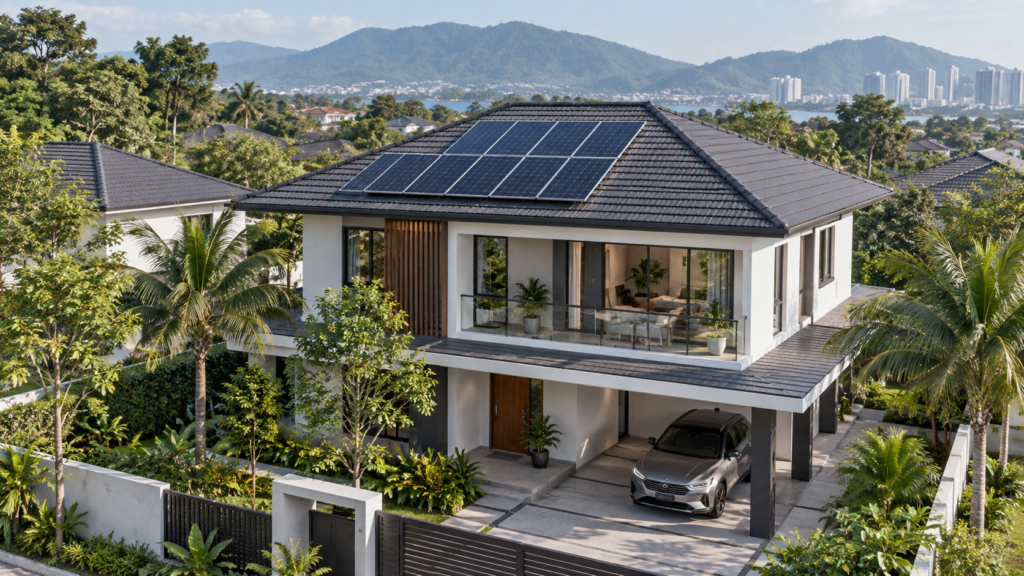
Rooftop solar has become one of the most practical ways for Malaysian homeowners to take control of rising electricity costs. But a solar system is a 25-year investment sitting on your roof, so it pays to understand the basics before you sign a quotation. This guide covers what matters most: your roof, your electricity habits, your budget, and what to expect once the system is running.
How a home solar system works
Solar panels on your roof convert sunlight into direct current (DC) electricity. An inverter converts this into alternating current (AC), the type your home uses. During the day, your appliances use solar power first. When the panels produce more than you need, the surplus flows out to the TNB grid and earns you a bill credit under the Solar ATAP programme. At night, or when it rains, your home draws from the grid as usual.
In other words, solar does not take you off the grid. It reduces how much you buy from TNB and earns credit for what you send back.
1. Check your roof type and available space
Your roof decides how many panels you can fit and how they are mounted. As a rough guide, each kilowatt-peak (kWp) of modern panels needs about 5 to 6 square metres of clear roof, so a 5 kWp system needs roughly 25 to 30 square metres facing the sky.
| Roof type | What to know |
|---|---|
| Metal deck (e.g. clip-lock, trimdek) | Simplest and fastest to install. Panels are clamped to the roof ribs, so there are few or no roof penetrations. |
| Concrete or clay tiles | Very common on Malaysian landed homes. Hooks are fitted under the tiles; a careful installer replaces cracked tiles and seals properly to avoid leaks. |
| Flat concrete slab | Panels sit on tilted frames. Good for orientation, but the slab's waterproofing and drainage must be checked first. |
Also consider:
- Shading. Trees, water tanks, neighbouring buildings and parapet walls can cut output. Even partial shade on one panel can affect a whole string unless optimisers or micro-inverters are used.
- Orientation. Malaysia sits close to the equator, so east-, west- and south-facing roofs all work well. A low tilt is normal here.
- Roof condition. If your roof is due for repair, fix it before installing. Removing and reinstalling panels later adds cost.
2. Look at your TNB bill: daytime vs night-time usage
Two homes with the same bill can get very different savings from solar. What matters is when you use electricity.
- High daytime usage (someone at home, work-from-home, home office, daytime aircon): you use most of your solar directly, which saves you the full price of each unit. This gives the best return.
- Mostly night-time usage (everyone at work or school during the day): more of your solar is exported. Under Solar ATAP, exported units are credited at a lower rate than what you pay to import (see our article on NEM and Solar ATAP). Savings are still good, but this is where a battery may be worth considering.
If your home is on TNB's Time of Use (ToU) tariff, your bill already shows peak and off-peak usage separately. Otherwise, the myTNB app can show your daily usage if you have a smart meter. Share 6 to 12 months of bills with your installer so the system is sized to your real pattern, not a guess.
3. Size the system to your budget and the savings you want
There is no single "right" size. Solar is flexible: if you have a large roof, you can scale the system up or down to match your budget and your savings goal. A few limits and figures to keep in mind:
- Solar ATAP sizing for homes: installations above 5 kW for single-phase supply or 15 kW for three-phase supply require a Connection Confirmation Check (CCC). These are assessment thresholds, not unconditional maximum capacities; the proposed capacity is subject to technical approval.
- Typical output in Malaysia: roughly 110 to 120 kWh per kWp per month, depending on location, weather and shading.
- SuRIA Home rebate: RM600 per kWac, capped at RM3,000, for eligible Malaysian homeowners whose Solar ATAP system is commissioned by 31 December 2026 (or until the allocation runs out).
A simple illustration
A 5 kWp system on a standard domestic tariff (monthly use 1,500 kWh or below) produces about 575 kWh a month. Suppose the household uses 40% of that directly and exports the rest:
| Item | Units | Monthly value |
|---|---|---|
| Solar used directly (saves energy + capacity + network charges, 44.43 sen/kWh) | 230 kWh | about RM102 |
| Solar exported (credited at the energy charge, 27.03 sen/kWh) | 345 kWh | about RM93 |
| Total monthly benefit | 575 kWh | about RM195 |
That is roughly RM2,350 a year. If the system costs RM20,000 and receives the full RM3,000 SuRIA rebate, the net cost of RM17,000 would be recovered in about 7 years, with panels typically warranted for 25 years or more. This is an illustration only: AFA, service tax and the Energy Efficiency Incentive also affect your bill, and the export credit only offsets the units you buy from TNB in the same month. Ask for a proposal based on your own bills.
4. Is a battery compulsory? Not really
A battery is optional. Whether it makes sense depends on your budget and preference. Without a battery, your return takes a little longer than it did under the old NEM scheme, but under Solar ATAP you still get a fair return, especially if you use a good share of your solar during the day. A battery mainly helps homes that are empty in the daytime, and it can also provide backup during outages. Many owners start with panels only and add a battery later. If you think you might, ask for a hybrid-ready inverter. Read more in our guide to home solar batteries.
5. Is solar safe? A word on radiation
This is one of the most common questions we hear. Solar panels do not give off nuclear-type (ionising) radiation. They are passive devices that turn sunlight into electricity. Like every electrical appliance in your home, the inverter and cables produce a small, low-frequency electromagnetic field (EMF), comparable to a refrigerator or television. That field weakens quickly with distance. The panels are on your roof and the inverter is usually in the porch, store room or garage, away from where people spend most of their time.
6. Maintenance and cleaning
Solar systems need very little upkeep. Malaysia's frequent rain washes off much of the dust, but bird droppings, leaves, haze residue and dust from nearby construction can build up over time.
- As a general guide, professional cleaning about once every 3 years is enough for most homes.
- Better still, let your monitoring app tell you. Compare output on similar sunny days. If generation drops noticeably and stays low, it is time to clean or inspect. Clean only when performance drops.
- Do not climb onto the roof yourself or use high-pressure jets or harsh chemicals; these can damage panels and void warranties.
- Check the inverter's status lights or app for error messages, and keep the area around it ventilated and clear.
7. Choose your installer carefully
- Use a SEDA-registered PV Service Provider (RPVSP). Only registered providers can submit Solar ATAP applications.
- Ask for warranties in writing: panel product and performance warranties, inverter warranty, and workmanship and roof-leak warranties.
- Make sure the quotation lists brands, model numbers and system size in both kWp (panels) and kWac (inverter). The SuRIA rebate is based on kWac.
- Confirm that the installer handles the paperwork: the ATAP application, TNB meter change and the SuRIA rebate submission.
Key takeaways
Check your roof type, space, shading and condition first.
Your day-versus-night usage decides how much you save and whether a battery is worth it.
Size the system to your bill, roof and budget, subject to the applicable ATAP technical assessment and approval requirements.
A battery is optional; solar without a battery still gives a fair return under ATAP.
Solar panels are not radioactive; EMF levels are similar to everyday appliances.
Clean about every 3 years, or when your monitoring shows output dropping.
Talk to Mercure Engineering
Not sure what size suits your home? Send us your last few TNB bills on WhatsApp and Mercure Engineering will prepare a system proposal based on your actual usage, including your SuRIA Home rebate eligibility.
References
- SEDA Malaysia: Solar ATAP general information
- SEDA Malaysia: SuRIA Home rebate announcement
- The Edge Malaysia (8 Jun 2026): What homeowners should look at before buying a solar PV system
Related guides
NEM and Solar ATAP: Understanding the Programmes
Home Solar Batteries: Sizing, Costs and What to Expect
SuRIA Home Rebate: How to Claim Up to RM3,000 for Your Home Solar System